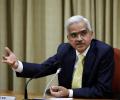
Reserve Bank Governor Shaktikanta Das on Thursday said cryptocurrencies are a "threat to macroeconomic and financial stability" and cautioned investors against punting on them, days after the Union government's move to tax the gains made from cryptocurrency trades. In the Union Budget for 2022-23 presented in Parliament on February 1, the government proposed levying a 30 per cent tax on gains made on cryptocurrency trades by investors and the announcement was welcomed by cryptocurrency industry players, saying it legitimises their trades. Das invoked the 17th century 'tulip mania', widely considered to be the first financial bubble, to caution investors, saying the cryptocurrencies do not even possess the value of the exotic flower.

Finance Minister Nirmala Sitharaman is scheduled to address the post-budget meeting of the RBI's central board on Monday and highlight key points of the Union Budget 2022-23, including the fiscal consolidation roadmap and high capex plan. It has been a custom that the finance minister addresses the RBI board, consisting of RBI Governor and existing four deputy governors, after the Budget. The meeting has been scheduled for February 14 where she would be addressing the board members and talk about announcements made in the Budget to perk up growth hit by three waves of COVID-19, sources said.

Events proved that on every count the RBI had accurately predicted both the damage and the lack of benefit. What the RBI was hiding was the fact that Modi had ignored its concerns -- all of which turned out to be true -- and gone ahead anyway, asserts Aakar Patel.

RBI's exercise will take into account standards of governance, the viability of the payment bank (PB) business model, and changes, if any, if needed.

Reserve Bank Governor Shaktikanta Das on Thursday said about 50 per cent of Rs 2,000 notes in circulation has come back in the banking system since the RBI announced withdrawal of the highest denomination currency last month. As on March 31, 2023, he said, Rs 2,000 notes worth Rs 3.62 lakh crore were in circulation. "So far, Rs 1.80 lakh crore have come back after the announcement," he said during an interaction with media after releasing the bi-monthly monetary policy here.

Tomorrow's review could also turn out be the last policy anchored by Rajan if the proposed Monetary Policy Committee (MPC) is put in place before the next review due on August 9.
After the screening, the shortlisted candidates will be vetted by an external committee, to be headed by former RBI governor, Bimal Jalan.

Describing the annual monetary policy announced by RBI Governor D Subbarao as a progressive one, Ernst & Young India's Ashvin Parekh said, "We have almost reached a point where inflation has become unmanageable and RBI has clearly indicated that bringing down inflation to a comfortable level is its top priority."

In the mid-quarter review on December 18, the Reserve Bank left key policy rates unchanged but said it will hike interest rates if inflation does not subside.
Reserve Bank of India (RBI) on Friday kept the benchmark interest rate unchanged at 4 per cent and decided to continue with its accommodative stance despite rising inflation. This is the 11th time in a row that the Monetary Policy Committee (MPC) headed by RBI Governor Shaktikanta Das has maintained the status quo. RBI had last revised its policy repo rate or the short-term lending rate on May 22, 2020 in an off-policy cycle to perk up demand by cutting the interest rate to a historic low.

Retail inflation dropped marginally to 7.01 per cent in June mainly due to slight easing in prices of vegetables and pulses, though it still remained above the Reserve Bank's comfort level for the sixth month in a row. The consumer price index (CPI) based inflation stood at 7.04 per cent in the preceding month of May and 6.26 per cent in June 2021. Inflation in the food basket in June 2022 was 7.75 per cent, compared to 7.97 per cent in the previous month, as per the National Statistical Office (NSO) data released on Tuesday.

In an interview with the Press Trust of India on Sunday, Finance Minister P Chidambaram explained that there was no "antagonism" between his ministry and the Reserve Bank of India (RBI).

The Reserve Bank on Thursday said it is considering the possibility of allowing Islamic financial institutions to function as NBFCs since Islamic banks are not permitted under the present laws.

Though COVID-19 and the subsequent lockdown left a trail of economic devastation on most countries, India can potentially build upon three positive aspects - push in the rural economy, stronger federalism and a huge consumption base, former RBI Governor Duvvuri Subbarao Rao has said. In his foreword on a Telugu book titled "Maandhyam Mungita Desam" (Nation in Recession) authored by Tummala Kishore, he said the challenge for the government in the months and years ahead is clear: to put the economy back on a healthy growth trajectory and ensure that growth is inclusive, with lower income households too enjoying the benefits of rapid growth.

Gandhi was the executive director at the Reserve Bank of India before being promoted to deputy governor post.

Sun Pharma was the top gainer in the Sensex pack, soaring around 6 per cent, followed by Kotak Bank, Axis Bank, IndusInd Bank, ICICI Bank, Dr Reddy's, Titan and TCS. NSE Nifty surged 121.35 points to 14,617.85.

The repo rate or the short term lending rate was increased to 7.5 per cent from 7.25 per cent.

The government wants the RBI to part with most of its profit as dividend.

The post of deputy governor (for economist) in RBI has been lying vacant since mid-June after Rakesh Mohan quit months ahead of his retirement.

Asked when the economy will revive, Das said it is difficult to make an estimate as there are many things which are still playing out.
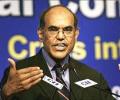
RBI Governor Subbarao also said an increase in non-performing assets at lenders was a matter of concern, but added that banks were well capitalised, during a media briefing at the conclusion of the central bank's board meeting.
Reserve Bank of India Governor Raghuram Rajan said, in an election year, it is better to be ready for any eventuality.

Economists praise Das for his pragmatism and willingness to face challenges head on. And in doing so with the finesse of an able administrator.

RBI Governor Shaktikanta Das on Tuesday launched a new service, which will enable over 40 crore feature phone users to undertake digital payments in a secure way. The service christened UPI (unified payments interface) '123PAY' is a three-step method to initiate and execute services for users which will work on simple phones which do not have an internet connection. Das said, as of now, the multifaceted features of UPI are mostly available only on smartphones, which excludes people from the lower rung of the society from an economic perspective, especially in the rural areas, from accessing the popular service, even though the smartphone prices are going down.

Observing that the economic recovery was not yet fully entrenched, the RBI Governor said recovery is likely to be gradual.

"The autonomy for the central bank, within the framework of the RBI Act, is an essential and accepted governance requirement. Government of India has nurtured and respected this," the finance minister said in a statement.
In the light of credit offtake not picking up despite ample liquidity in the system, the RBI is likely to keep policy rates unchanged in its annual monetary policy, to be unveiled on Tuesday, but may impress upon banks to step up lending to sectors slowing down.
In view of the need to enhance credit delivery to the employment- intensive micro and small enterprises sector, it has been decided to provide refinance of an amount of Rs 7,000 crore (Rs 70 billion) to the Small Industries Development Bank of India under the provisions of Section 17(4H) of the Reserve Bank of India Act, 1934.

For willful defaulters, change in ownership accompanied by punitive action against the defaulting management is the way to go.

Nowadays, our politics is habituated to sitting on a high pedestal, hobnobbing with world leaders, generating impressions of a superpower and returning to earth for the purpose of winning elections. In contrast, the yatra never left earth, observes Shyam G Menon.
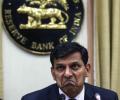
Will RBI chief have the final say, in the form of a veto

It is clear now that our policy to treat FCCBs as debt upfront turned out to be the right approach.

The mood at the Indian Institute of Management, Ahmedabad (IIM-A) is festive, with one of its alumnii, Raghuram Rajan taking over as the next Reserve Bank of India (RBI) governor.
Bringing their differences into open, outgoing RBI Governor D Subbarao took a dig at Finance Minister P Chidambaram for his comment once that he would "walk alone" to ensure growth in the face of tight money policy of the central bank.

Soaring vegetable prices pushed the retail inflation rate to a nine-month high of 5.49 pr cent in September, according to government data released on Monday. The consumer price index (CPI)-based retail inflation rate was 3.65 per cent in August and 5.02 per in September 2023. The previous high inflation rate was witnessed in December 2023 at 5.69 per cent.

Maintaining 4 per cent inflation is appropriate for India as targeting a lower rate could impart deflationary bias to the monetary policy, said a Reserve Bank paper. Under the current dispensation, the RBI has been mandated by the government to maintain retail inflation at 4 per cent with a margin of 2 per cent on either side. The paper, authored by RBI Deputy Governor Michael Debabrata Patra and another official Harendra Kumar Behera, has found a steady decline in trend inflation to 4.1-4.3 per cent since 2014.
In his first monetary policy review since taking office on September 4, RBI Governor Raghuram Rajan increased the repo rate by 25 basis points to 7.50 per cent.
Going by its past experience of differences between the central bank and the finance ministry, the government might prefer a person who could bridge this gap.

Credit card spending in September recorded strong growth of 25 per cent year-on-year (Y-o-Y), marking the highest increase in six months. Even as many banks saw higher slippages during the July-September quarter of 2024-25, spending growth exceeded 20 per cent for the first time since February. According to the latest data released by the Reserve Bank of India (RBI), September spending reached Rs 1.76 trillion, compared to Rs 1.42 trillion in the same period a year ago. In August 2024, credit card spending was Rs 1.68 trillion.

Reserve Bank of India (RBI) Governor Duvvuri Subbarao on Wednesday said inflation was still above the central bank's tolerance level and it would revisit the gross domestic product (GDP) growth numbers in its quarterly policy in January.
